Bullying and abuse among aged care advocates must stop

19 March 2019

There are a large number of voluntary aged care advocacy groups. Aged Care Crisis, Elder Care Watch, Aged Care Matters, Stop Elder Abuse, Angels for the Elderly, to name a few. Representatives of these voluntary groups spend hours upon hours talking with residents of aged care homes, recipients of in-home care, family members and staff.

The emergence of these voluntary advocacy groups raises an important question about the role of ‘consumer’ organisations funded by the federal government. Why are people seeking help from volunteers rather than COTA, National Seniors and OPAN?

The most common complaint about OPAN in Victoria is ‘the answering machine’. This financial year Elders Rights Advocacy received over $1.3 million from the National Aged Care Advocacy Program (NACAP) grant. Yet, when people phone Elders Rights Advocacy for advice/help, people say they are often greeted with an answering machine. Not surprisingly, these people go elsewhere for help.

Most voluntary aged care advocacy groups are extremely well intentioned. However, in recent years, some vigilante type aged care advocacy groups have emerged. Unlike Aged Care Crisis that rigorously contests claims made by governments and providers, these vigilante groups viciously attack individuals.

One of these vigilante groups operates under the name of Actioning Change for Aged Care. Some members of this group use Facebook in an attempt to destroy the reputations of people working in the aged care sector. In the beginning, they focused their attention primarily on providers. TriCare in Bundaberg was their first target. Next was Opal.

The most recent attack is focused on an aged care home in a small town in Queensland. Over the past 18 months, this vigilante group has conducted a relentless and vicious campaign against administration, staff and volunteers of Millmerran aged care home. With the use of out-dated records, they have raised multiple vexatious complaints with the Aged Care Complaints Commissioner. They have also posted hateful remarks about aged care workers and their family and made numerous threats. The reasons for this ongoing attack can be attributed to personal grudges and the fact the community dared to contradict their claims and fight back.

This vigilante group bases its attacks on anecdotes not evidence. Members of this group claim naming and shaming is in the “public’s interest”, irrespective of whether there is any substance to their attacks. Fortunately journalism’s code of ethics requires an independent investigation of claims of neglect in an aged care home before such claims are reported.

This document  demonstrates the ongoing atrocious, vulgar, bullying and harassing behaviour from those who claim to be aged care advocates. As you will see, their abuse is not limited to individual aged care providers. They also attack individual aged care workers and even volunteers.

This vigilante group also attack other aged care advocates. Stewart Johnston (Oakden whistle blower), Charli Maree Darragh Matterson (Angels for the Elderly), Maria Berry and me (Aged Care Matters) have all been victims of online abuse. There are others who prefer not to be named.

The Internet has enabled a small group of women to disrupt many people’s lives. Take Stewart Johnston for example. Since his mother was abused in Oakden, Stewart has worked tirelessly to help reform the aged care system. Yet members of this vigilante group attacked and ridiculed him.

I have also had the misfortune to read some abusive Facebook posts directed at Charli Maree Darragh Matterson. After Charli’s mother was murdered in an aged care home, these sadists chose to bully and intimidate her by posting repugnant images and hateful comments on Facebook. This ongoing abuse made Charli feel suicidal.

Unfortunately, Facebook turns a blind eye to trolls and bullies whose relentless abuse has caused suicides, depression and other mental health issues. By not adequately controlling trolling, Facebook is condoning sadists’ despicable behaviour.

I am the most recent victim of Internet abuse by a member of the Facebook group Actioning Change for Aged Care. Rather than call this person a troll, I call her “an abuser” because the abuse was sent via private messages.

Soon after I left Aged Care Matters’ Facebook group, the Internet abuse began: “Fancy telling people in Aged Care Matters Facebook group that you’re broke! You own your house and a beach shack. Yep, you’re struggling! That’s so offensive to people who are broke.”

The conventional wisdom of the Internet is to ignore abusive messages. However, I chose to engage with humour. “I can’t eat my house”. The abuser then replied: “Sell a house”.

The next message was directed at my approach to aged care advocacy: “People are sceptical and think you are captured because you have lunches with providers and peak bodies. You think [they] are decent people.“

The abuser continued: “Like every other advocate, your advocacy has not been affective.  Meetings with ministers, aged care providers and peak body groups have amounted to pretty much nothing. It was 4 Corners who where (sic) instrumental in forcing a Royal Commission, not you. No advocates are taken seriously. And as much as you talk and write, nothing has changed. So perhaps try a different tact (sic).”

I engaged: “Do you suggest I adopt your tactic and spew meaningless insulting Facebook posts?”

The abuser would not be silenced: “Not in a million years would I have lunch with people who have knowingly protected organisations that have neglected and abused the elderly for years. When are you having lunch with George Pell?”

I could not resist replying: “George Pell is a convicted paedophile. [The people you refer to] are not paedophiles. They are simply people with whom you disagree.”

I had clearly stated that people who work in industry are people with whom these abusers disagreed. Yet the abuser quickly shot back an absurd reply: “Misleading of you to suggest I think your mates [in industry] are paedophiles.”

The next message was equally nonsensical: “Pell knew about the abuse in the church and did nothing about it. Same as your mates have known about the abuse in aged care for years and have done what?”

At this point, I stop engaging. Instead I took a screen shot of the private messages and shared them on social media.

Then the threats began:  “You’re a complete and utter moll. Take that down at once or I will truly expose you for the person you are… I will be filing for an intervention order on Monday.”

I continued to use humour: “Monday is a public holiday. Best to do it on Tuesday.”

Calling me a moll and making threats (e.g. to call the police, apply for an intervention order or sue for defamation) are tactics frequently used by this group. These threats have no substance. A month later, I am still waiting for the intervention order!

Most vicious messages are rants that can easily be ignored. However, some posts are deadly serious. The registered nurse in the group posted advice about how to commit murder undetected.

The women in this small cabal claim to be whistle-blowers and aged care advocates. However, their Facebook posts show they are more interested in conducting campaigns of abuse than aged care reform. It is ironic that members of this group post memes denouncing those who bully. It is definitely a case of the pot calling the kettle black.

These women call for respect of older people in aged care homes while they demonstrate disrespect towards anyone who disagrees with them.  For example, a man who volunteers by taking Millmerran’s aged care residents on bus excursions questioned the claims made by these vigilantes. He then became the subject of their abuse. They ridiculed and bullied him, describing him as the “Old Bus Driver”.

A recent petition collected over 300,000 signatures from people who are concerned about standards of care in aged care homes. Under normal circumstances, this petition would cause the government to sit up and take notice. However, its association with a toxic, abusive group of women seriously undermines the petition’s credibility.

It is clearly not only unscrupulous providers who need to leave the aged care sector. Immoral people who abuse and threaten on the Internet have no place in aged care advocacy.
 

Open disclosure is needed in all aged care homes

18 April 2019

How often does an incident in an aged care home escalate because management is afraid of litigation?

When a mistake occurs in a public health service, the person who has been affected and/or their legal representative must be informed about the ‘adverse event’. This is known as ‘open disclosure’.

Open disclosure is defined as “the open communication that takes place between health practitioners and patients after an adverse event”.  An open disclosure process includes: An apology or expression of regret; a factual explanation of what occurred; an opportunity for the affected patient to relate their experience; and the steps taken to manage the event and prevent its recurrence.

Legislation mandates open disclosure in all public health services in Australia, though each state has different legislative requirements. In Victoria, for example, the Victorian Charter of Human Rights and Responsibilities Act 2006, requires health care practitioners to discuss an adverse event with the person who has been affected and/or their legal representative.

There are around 2,700 aged care homes in Australia. Only 5 per cent of these are government owned. The other 95 per cent are private or not for profit. Although government owned aged care homes require open disclosure, there is no legislative requirement for open disclosure in private or not for profit aged care homes.

When an adverse event occurs in an aged care home, some managers inform the resident’s legal representative. These managers also respond respectfully and in a timely manner to requests for information about the adverse event. In these cases, the situation rarely escalates.

In contrast, when a manager is not open about an adverse event and does not provide accurate information about what happened, the situation can quickly escalate. With the media’s insatiable appetite for horror stories about aged care homes, these stories often make headline news.

A month ago, a 94-year-old woman was resuscitated in an aged care home despite having an advanced care plan stipulating Do Not Resuscitate. The family watched their mother and grandmother die a slow and seemingly painful death in a hospital palliative care unit, rather than die peacefully after breakfast.

Despite numerous attempts to find out exactly what happened, a month later the daughter still did not know why/how/who resuscitated her mother.

The quest for information began two days after her mother was transferred to hospital. The manager of the aged care home phoned. He said to the daughter: “I heard your mum got resussed on Saturday”. This was the first time the daughter was told her mother had been resuscitated.

How did a woman with an Advanced Care Plan that clearly stated Do Not Resuscitate get resuscitated?

During a time when the daughter should be grieving, she instead tried to get information. Who made the decision to resuscitate her mother? Where was she resuscitated (in the lounge room or in her bedroom)? What did her doctor advise the staff to do? What did the Ambulance Victoria advise over the phone?

She phoned the aged care home’s head office. She left voice messages that were not returned. She sent emails that were not answered. Eventually she spoke with the District Manager who undertook to investigate what happened.

Aged care homes need to prepare themselves for open disclosure. Standard 6 of the new Aged Care Quality Standards states: “Appropriate action is taken in response to complaints and an open disclosure process is used when things go wrong”.

By the time the daughter contacted me, she had heard several different versions of the event. The Manager of the aged care home, the District Manager, the hospital doctors, the aged care home’s progress notes all provide different accounts about what happened that Saturday morning.

The daughter was so frustrated she was ready to tell her story to the media.

Instead, I suggested she lodge a complaint with the Aged Care Quality and Safety Commission and sought advice from Elders Rights Advocacy. I also suggested she requested an urgent face-to-face meeting with the District Manager.

The District Manager agreed to a meeting. She asked an employee of Elders Rights Advocacy to accompany her as a support person. However, this is not a service Elder Rights Advocacy provides after a resident has died.

I contacted the CEO, OPAN to ask where someone in her position should go for help. Although the National Aged Care Advocacy Framework focuses on the older person, the framework has recently been expanded to include families or representatives.

I agreed to be the support person in the meeting with the District Manager. Unfortunately, an hour before it was scheduled, the daughter received a phone call to inform her that the meeting had been cancelled. There were unforeseeable circumstances.

To prevent this escalating, I immediately phoned the aged care company. I left a message explaining the importance of the CEO returning my call. I did not feel confident that he would.

Much to my relief, the CEO phoned back. I told him the daughter simply wanted a factual explanation of what had occurred, a genuine apology and to know what steps have been taken to prevent its recurrence. She wanted ‘open disclosure.’

I arranged a meeting so the daughter could hear the truth about what happened to her mother. A month after her mother was resuscitated in an aged care home, the daughter now has a time-line to show exactly what happened. She also received a heart-felt apology. During the meeting, we discussed ways to prevent a similar tragedy.

This incident demonstrates an urgent need for aged care homes to have policies to ensure residents are not resuscitated against their wishes. Residents and their families are encouraged to make advanced directives to state their wishes for end-of-life medical care. These advanced directives are meaningless unless health care professionals respect an older person’s wishes.

Aged care homes must ensure direct care staff on each shift know which residents are, and are not, for resuscitation. Each handover sheet should identify residents who have documented Do Not Resuscitate in their advance care plan. This is particularly important for agency staff.

I once arrived at an aged care home to find a fire truck, 2 Mobile Intensive Care Unit Ambulances (MICA), a paramedic motorcycle and an ordinary ambulance. All these flashing lights heralded the death of a 94-year-old resident. This may suggest that Ambulance Victoria needs some education when they receive a 000 call from an aged care home.

A doctor once told his colleagues that, when he reached a certain age, he would have “NOT FOR RESUSCITATION” tattooed on his chest. This would undoubtedly guarantee his wishes were respected.

Currently, residents in aged care home must ‘opt out’ of resuscitation. They do this by indicating Not for Resuscitation in their advanced care plan and advanced care directive. It may be better to make cardiopulmonary resuscitation an “opt in” for residents in all aged care homes. Only those residents who choose to be resuscitated will be. Others will be allowed a dignified death.

Google Translator Did Not Help Me Understand The Aged Care Workforce Strategy Taskforce Report

6 December 2018

According to the script of the TV series ‘Yes Minister’, there are two basic rules of government: Never look into anything you don’t have to. And never set up an enquiry unless you know in advance what its findings will be.

During the past decade, there have been many inquiries, reviews, consultations, think tanks and a task force into aged care. These inquiries have resulted in a large number of recommendations, most of which have been ignored by successive governments.

The Aged Care Workforce Strategy Taskforce kicked off in December 2017 with a so-called “Summit”. As an attendee, I was given a lanyard with the slogan: “Think. Collaborate. Innovate”. The slogan, the free hug video and the break out sessions left me feeling discombobulated. However, the lunch was delicious.

With a $2 million dollar budget (courtesy of the Australian tax-payer), I expected the taskforce to answer the million-dollar question: Will standards of care be improved by the government mandating staffing ratios in aged care homes?

Everyone has an “opinion” about staffing ratios. Jane Seaholme’s change.org petition “Mandate aged care staff/resident ratios” has around 300,000 supporters. Staff, relatives, residents, aged care advocates and unions all support staffing ratios in aged care homes. In contrast, those with power – politicians, peak bodies and providers – oppose staffing ratios. They defend their position by citing the 2011 Productivity Commission Report.

To settle the disagreement about the value of ratios in aged care homes, the taskforce needed data about actual staffing levels and quality outcomes in Australian aged care homes. They also needed to compare this data with international data. This would have provided evidence to support or refute the following claim: ‘Aged care homes with a higher staff-to-resident ratio have higher standards of care’.

Several researchers, including those at the Australian Association of Gerontology, encouraged the Chair of the taskforce to undertake a systematic literature review on staffing. A rigorous review of the evidence would have been money well spent. Instead, an annotated bibliography that lacked any critical analysis was commissioned.

Rather than rely on evidence, the taskforce regurgitated industry “opinions” about staffing ratios cited in the Productivity Commission and Tune Reports. Not surprisingly, staffing ratios were once again dismissed.

What was surprising, however, is the Report of the Aged Care Workforce Strategy Taskforce dismissed staffing ratios with only one sentence. “Static models or set staffing ratios will not assist in meeting these expectations or necessarily result in better quality of care outcomes.”

Rather than focus on the evidence, the report provides a transformational ‘Belief Statement’: “We exist to inspire people to want to care, enable people to properly care and enhance life through care. Because how we care for our ageing is a reflection of who we are as a nation.

This belief statement and the Unifying Vision of Care set the tone for this 40,000-word report. It is overflowing with jargon, modern management language and Don Watson’s so-called weasel words. This made the report difficult to read. The unifying vision of care (see Vision below) appears to follow the amusing instructions of “How to write a manifesto”.

A Unifying Vision of Care (Report of the Aged Care Workforce Strategy Taskforce, P 13)

Have you ever heard the laughter of a life fully lived?
Or been lost in the stories of someone who has traveled a million roads — and back?

We have.

Have you ever seen a person confined to a single room, whose only crime is to grow old?

We have.

Have you ever pondered why it is that being old is somehow being less?

We have.

In a world of youthful beauty, constant change and shortened use by dates, we have seen how
the simple act of stopping to learn, listen to and help our community’s older members,
has for many, become too hard.

We seek to change that.

We are the people who have the privilege to care for our ageing and we believe, deeply,
that access to good care must be easier and that the very notion of caring must change
from reactive and daunting — to proactive and inspiring.

We champion the simple ethos of a life well lived.

We want to inspire people to want to care; not feel the burden of having to.

And we strive to enable people to properly care — for their neighbours, friends or family.

Above all, we exist to enhance life through care —
from the moment the smallest help is needed to the moment the final breath is taken.

As aged care professionals we choose to care;
everyday, for every type of human in every type of condition.

Because ultimately, we believe how we care for our ageing
is a powerful reflection on who we are as a nation
.

It is not my intention to be disrespectful, but I needed to use google translator to understand the taskforce’s approach to building the workforce strategy: “The taskforce recognised that the strategy must be disruptive in its thinking, transformational in its approach, pragmatic to implement, and supportive of immediate improvements”. Huh?

I also needed google translator to ‘look forward’: “Looking to the future, the aged care industry requires a coherent strategy and key enabling infrastructure to support the strategic investment, translation and uptake of innovations designed to improve workforce capability, care quality and effectiveness”. Goodness me.

I am also unfamiliar with this lingo: “touchpoints for consumers in their ageing journey”, “a well-supported research translation pipeline” and “the creation of a research translation ecosystem”. Touchpoints, pipelines and ecosystems. What planet are you on?

One thing, however, was clear: the strategy was “developed with the industry, for the industry”. The bias towards an ‘industry-led’ (i.e. not a ‘consumer-led’) strategy was explicit. The aim was “to develop an industry-led strategy focused on the consumer”. Having no union or genuine consumer representation on the taskforce committee was also an ominous sign.

Not surprisingly, given the report’s abstruse language, the taskforce developed complex processes to address staffing issues. The success of these recommendations depends, in part, on a voluntary code of conduct by industry. These codes only apply to those providers who sign up to them. Good luck with that.

Unfortunately google translator did not help me to understand the findings of The Annual Aged Care Survey. I did, however, understand Korn Ferry, a US corporate giant, was commissioned by the taskforce to undertake this staff survey. I certainly wish someone would offer me $90,750 for doing a tick-a-box survey and then running the responses through a statistical computer program.

According to the report: “Korn Ferry knows more about human performance in the workplace than any other organisation.” Apparently “in order to open up career pathways, there are well-established and research-backed corporate methodologies that can be utilised to enable interaction between job families and opportunities to move across job families”.

Without explaining who or what are “job families”, or indeed the “Job Family Framework” methodology, Korn Ferry produced a colourful report – one for all the family. However, the analysis is poorly explained. Even with my expertise as a researcher, I could not make head or tail of it. Who could?

Reading the taskforce report, I was again reminded of the TV series ‘Yes Minister’, specifically one of Sir Humphrey Appleby’s most memorable quotes: “ I do see that there is a real dilemma here. In that, while it has been government policy to regard policy as a responsibility of Ministers and administration as a responsibility of Officials, the questions of administrative policy can cause confusion between the policy of administration and the administration of policy, especially when responsibility for the administration of the policy of administration conflicts, or overlaps with, responsibility for the policy of the administration of policy.”

Like Sir Humphrey Appleby, the taskforce report has a lot of words. But who understands them? And more importantly: who cares?

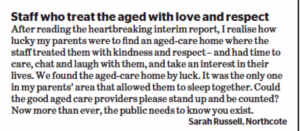
Staff who treat the aged with love and respect

Letter, The Age, 2 November 2019

After reading the Aged Care Royal Commissioner’s heart breaking interim report, I realise how lucky my parents were to find an aged care home where the staff treated them with kindness and respect – and who had time to care, chat/laugh with them and take an interest in their lives.

We found the aged care home by luck. It was the only aged care home in their area that allowed them to sleep together.

Could the good aged care home providers please stand up and be counted? Now more than ever, the public needs to know you exist.

Rethinking The Staff-Quality Relationship In Aged Care Homes

1 October 2018

The Aged Care Minister and provider peak bodies were recently asked to explain their opposition to mandating minimum ratios  of registered nurses in aged care homes.

This led to an opinion piece in which their claims were contested.

The Aged Care Guild has recently used a financial argument to oppose ratios, and priced mandated ratios as an extra $5 billion per year.

This is a bit rich from a peak body that represents the 8 biggest aged care providers – some with executives on extremely high salaries.

An article in the Daily Telegraph states: “The bosses of the biggest six aged care companies pocket seven-figure salaries and churn through $2.17 billion in taxpayer funds a year”.

Rather than use a financial argument, the government is using research from The Netherlands to support their opposition to ratios.

A letter from Office of the Hon Ken Wyatt MP contains the following paragraph:

“One of the latest staffing studies, compiled in April this year in The Netherlands, states: “There is no consistent evidence of a positive relationship between the quantity of staff and quality of care”.

It says: “We should think beyond numbers. Instead of focusing on the quantity of staff, we welcome initiatives that consider the quality of a team”.

I have read the research that is referred to in the Minister’s letter, and my assessment is the Office of the Hon Ken Wyatt MP has misinterpreted the findings of the Dutch research.

In 2016, Backhaus, Beerens, Van Rossum, Verbeek, and Hamers undertook a literature review for the Dutch Ministry of Health, Welfare and Sports.

The aim of the literature review was to summarise all the available evidence on the relationship between staffing and quality in aged care homes.

The editorial “Rethinking The Staff-Quality Relationship In Nursing Homes” (2018) provides evidence of a positive relationship between the quantity of staff and quality of care.

This is a matter of fact, not opinion.

It is important to critically read research papers, not to cherry pick sentences that support your position.

Although the authors state: “There is no convincing scientific evidence of a positive relationship between staffing levels or the educational background of staff and quality in nursing homes”, this statement needs to be critically examined.

The first question to ask is: Why did only a small number of studies meet the inclusion criteria?

The answer is crucial to the interpretation of the study. In many countries, there is a lack of data to analyse the relationship between staffing levels or the educational background of staff and quality in nursing homes.

It is simply not possible to undertake rigorous studies on staffing because data is either non-existent or not available to researchers.

In Australia, the data is collected by the Department of Health and financial organisations (e.g. StewartBrown) but this data is not available to the public, including researchers.

In contrast, the US not only collects data but also makes this data available to the public.

So it is important to note that Backhaus and her colleagues stated: “Studies that found a positive relationship [between the quantity of staff and quality of care] were mostly conducted in the US.”

The only country that analyses data on staffing and quality indicators showed a positive relationship.

The US data shows the more staff on duty, the higher the quality of care.

It is therefore not correct to conclude: “There is no consistent evidence of a positive relationship between the quantity of staff and quality of care”.

There is evidence. This evidence is found in the only country that not only collects data on quality indicators but also makes this data available to the public.

Clearly, quantity of staff is not the only determinant of quality of care. But it is a determinant.

Other important determinants are the quality of the team, the manager of the aged care home (responsible for staff morale, supervision etc.) and the owner of the aged care home licence.

It is noteworthy that over the past 20 years only 183 studies undertaken met the inclusion criteria for this literature review.

The most obvious conclusion to draw from this low number is the urgent need to undertake rigorous research.

In Australia, such a study could easily be undertaken. All Victorian-owned aged care homes have mandated ratios.

This provides the perfect ‘laboratory’ – both a control group (Victorian-owned) and an experimental group (private and not-for-profit).

Quality outcomes in Victorian-owned aged care homes could be compared with those in private and not-for-profit aged care homes.

The recent Aged Care Workforce Strategy Taskforce could have undertaken this research.

However, this taskforce morphed into an “industry led” Workforce Strategy Taskforce. Once again, “consultation” and “expert opinion” trumped evidence.

We urgently need empirical evidence to determine the relationship between the numbers and training of staff and standards of care in an aged care home.

This research is needed so we can have an evidence-based policy rather than one that is based on opinions.


‘I’d rather die’: the horror stories of aged care don’t tell the whole story

Troubling media reports have undoubtedly contributed to the government announcement of a Royal Commission. It is vital that incidents of inadequate personal care, negligence, neglect, abuse and assault are reported. However, we hear much less about elderly people who are living happily in an aged care home.

Guardian

What is it like to work in an aged care home?

26 July 2018

Aged care homes are places where our most frail and vulnerable older people live. How do we ensure the highest possible standards of care in aged care homes? Some claim a consumer driven and market based residential aged care system will provide ‘world class’ care; others claim we need effective regulation, government intervention and increased transparency to prevent neglect in aged care homes.

In recent years, there have been numerous heart-breaking stories about aged care homes. When stories about inadequate personal care, neglect, abuse and negligence are reported in the media, the aged care industry dismisses these stories as ‘one-offs’. But are they?

To answer this question, we need to hear from people who have first-hand experiences in aged care homes – residents, relatives and staff. They know what day-to-day life is like in aged care homes.

I recently asked relatives about the aged care home they visited. By sharing positive and negative views about aged care homes, and suggestions about how residents can have the best possible quality of life, relatives provide a rich source of experiences to inform policy. I have also interviewed residents.

I am now seeking the views of staff who work in an aged care home. Staff are often hard working, dedicated people doing a very difficult job for not much pay or professional kudos.

Managers, nurses, personal care attendants, kitchen, activities, reception, cleaning and maintenance staff are encouraged to share their first-hand experiences of working in an aged care home. We need to listen to staff’s experiences of their day-to-day work in an aged care home. We also need to know more about the working conditions in aged care homes.

There are around 2,700 aged care homes in Australia. Although many are excellent, some operate without enough staff. Unlike childcare centres, hospitals and schools, there is no federal legislative requirement for aged care homes in Australia to have staff-to-resident ratios or skill prerequisites.

Should ratios be introduced? Or are most aged care homes adequately staffed?

Would you recommend the aged care home where you work to your parents?

These are the type of questions that need to be answered to ensure an evidence-based approach to aged care policy.

Staff who participate in this study will be asked to reflect on what you like about your work, and what you don’t like. I am also seeking ideas for improving residents’ quality of life. If you could change three things in the aged care home in which you work, what would you change?

The survey begins with open-ended questions. This gives staff an opportunity to say as much or as little as you like about whatever you want.

All information will be kept confidential. No identifying information about you or the aged care home where you work will be published.

If your first language is not English, you may answer questions using your first language.

I am also collecting information about staffing levels in aged care homes. What is the ratio of registered nurses-to-residents in the aged care home in which you work? Is a registered nurse on site 24 hours a day?

The more survey responses I receive from staff, the stronger the findings. The findings will be used to lobby for improvements in working conditions for staff in aged care homes. Improved working conditions are not only important for staff but will also ensure a better quality of life for residents.

If you would like to share your views, please click here.